Producción de enzimas proteolíticas a partir de microorganismos halófilos aislados de suelos salinos del sur de Sonora
Production of proteolytic enzymes from halophilic microorganisms isolated from saline soils in southern Sonora
DOI:
https://doi.org/10.63622/RBS.2509Palabras clave:
Halófilos, fermentación, enzimas, actividad proteolíticaResumen
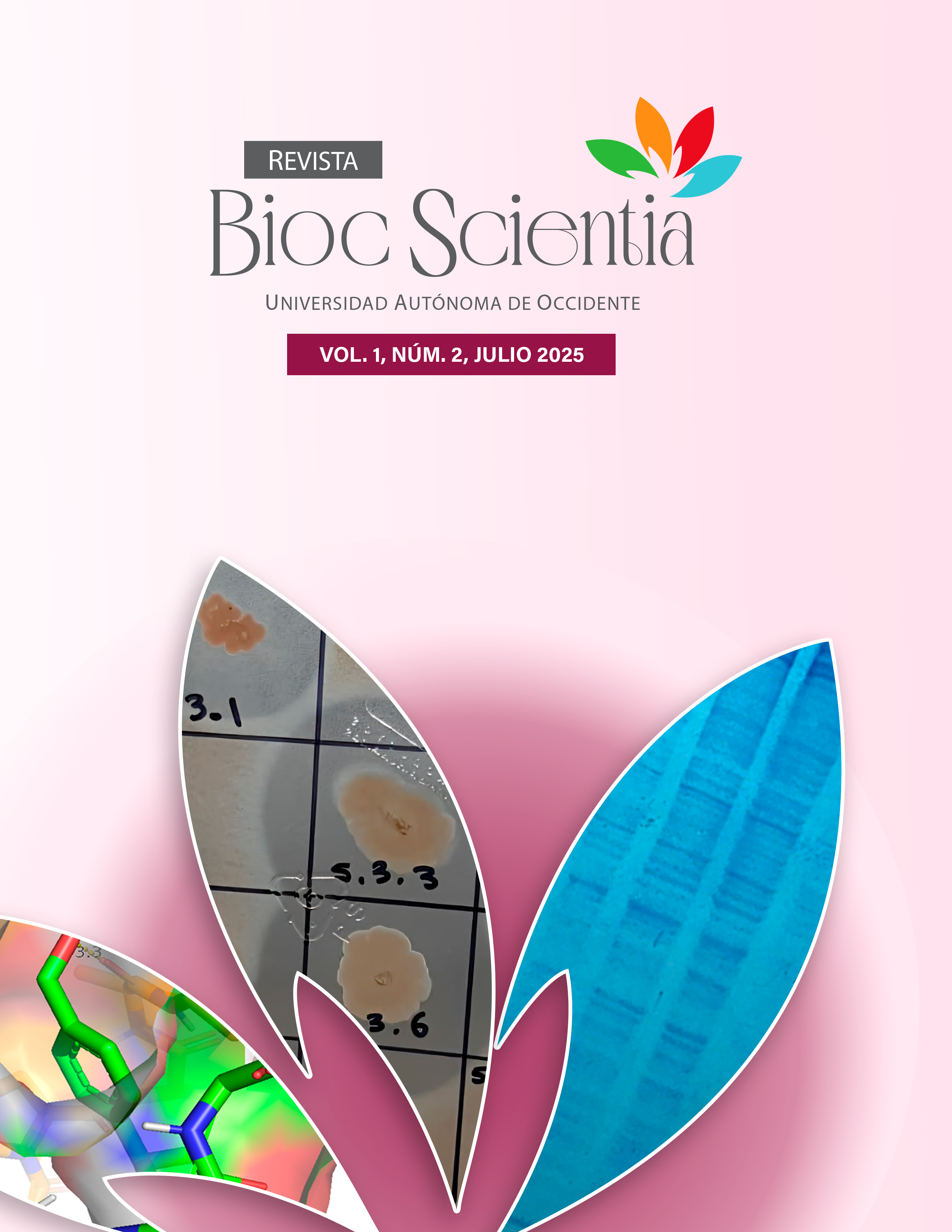
Los halófilos son microorganismos que se encuentran creciendo en ambientes con ele-vadas concentraciones de sal. En los últimos años se ha mostrado un creciente interés en el estudio de estos microorganismos por su gran potencial biotecnológico, principalmente en la obtención de enzimas de importancia en la industria. Las muestras analizadas fueron tomadas en puntos aleato-rios de la costa de la Bahía de Santa Barbara, Sonora, México. Se identificó el crecimiento de 287 colonias en los medios de cultivo utilizados (agar marino 1217 y ATCC 2185) a concentraciones de NaCl de 0.5, 2 y 4 M, 35 colonias presentaron halo de hidrólisis en medio marino 0.5 M, 7 colonias en medio marino 1217 2 M y 4 colonias en medio ATCC 2185 2 M NaCl, todos enrique-cidos con 2 % de leche descremada como inductor de la actividad proteolítica. Asimismo, se seleccionaron cinco cepas (5.3.3, 5.3.4, 5.3.6, 5.3.8 y 4.2.11) en función de los mayores diámetros del halo de hidrólisis presentado en el medio con inductor. La determinación de la concentración de proteínas indicó que la cepa 5.3.8 presentaba la concentración más alta iniciando con 144.4555 μg/mL. Por otro lado, la mayor actividad proteolítica se identificó a partir de las 144 horas del proceso fermentativo, siendo la cepa 5.3.3 la que mostró la mayor actividad. Específicamente se encontraron actividades enzimáticas de: 0.2875, 0.0402, 0.2201, 0.2323 y 0.2035 U/mL para las cepas 5.3.3, 5.3.4, 5.3.6, 5.3.8 y 4.2.11. Estos resultados sugieren la presencia de cepas halófilas leves aisladas de suelos salinos con capacidad de producir proteasas con potencial biotecnológico.Referencias
Abd Samad, N. S., Amid, A., Jimat, D. N., and Shukor, N. A. 2017. Isolation and identification of halophilic bacteria producing halotolerant protease. Science Heritage Journal, 1(1), 7-9. https://doi.org/10.26480/gws.01.2017.07.09
Alnahdi, H. S. 2012. Isolation and screening of extracellular proteases produced by new isolated Bacillus sp. Journal of Applied Pharmaceutical Science, 2(9), 071-074. DOI:10.7324/JAPS.2012.2915
Benmebarek, H., and Kharroub, K. 2023. Production Assay and Partial Characterization of a Protease Produced by Idioma-rina loihiensis, a Moderately Halophilic Bacterium Strain. In Biology and Life Sciences Forum (Vol. 31, No. 1, p. 18). MDPI.
Bradford, M. M. 1976. A rapid and sensitive method for the quantitation of microgram quantities of protein utilizing the principle of protein-dye binding. Analytical Biochemistry, 72(1-2), 248-254.
Camacho, R. M., Martínez, R., B. and Camacho, M. 2023. Cuantificación de proteasas haloalcalinas empleando un método cinético basado en pH. Manual de métodos para el estudio de extremófilos. Universidad Autónoma del Estado de Morelos. DOI: 10.30973/2023/manual-extremofilos
Chung, D., Yu, W. J., Lim, J. Y. et al. 2021. Characterization of the proteolytic activity of a halophilic Aspergillus reticulatus strain SK1-1 isolated from a solar saltern. Microorganisms, 10(1), 29. https://doi.org/10.3390/microorganisms10010029
Chung, D., Yu, W. J., Lim, J. Y., Kang, N. S., Kwon, Y. M., Choi, G., ... and Lee, D. S. 2021. Characterization of the proteolytic activity of a halophilic Aspergillus reticulatus strain SK1-1 isolated from a solar saltern. Microorganisms, 10(1), 29. https://doi.org/10.3390/microorganisms10010029
Condalab. (2020). Ficha técnica: Caldo Marino Cat. 1217. https://www.condalab.com/int/en/dehydrated-culture-media/984-11616-marine-broth.html
Deole, R. and Hoff, W. D. 2020. A potassium chloride to glycine betaine osmoprotectant switch in the extreme halophile Halorhodospira halophila. Sci Rep 10, 3383. https://doi.org/10.1038/s41598-020-59231-9
Drissi-Kaitouni, L.B., Anissi, J., Sendide, K. et al. 2020. Diversity of hydrolase-producing halophilic bacteria and evaluation of their enzymatic activities in submerged cultures. Ann Microbiol 70, 33. https://doi.org/10.1186/s13213-020-01570-z
Edbeib, M.F., Wahab, R.A. and Huyop, F. 2016. Halophiles: biology, adaptation, and their role in decontamination of hypersaline environments. World J Microbiol Biotechnol 32, 135. https://doi.org/10.1007/s11274-016-2081-9
Fahmy, N. M., and El-Deeb, B. 2023. Optimization, partial purification, and characterization of a novel high molecular weight alkaline protease produced by Halobacillus sp. HAL1 using fish wastes as a substrate. Journal of Genetic Engineering and Biotechnology, 21(1), 48. https://doi.org/10.1186/s43141-023-00509-6
Fitriyanto, N. A., Hadi, S., Bahtiyar, M. I., Prasetyo, R. A., and Erwanto, Y. 2020. Characterization and growth profile of proteolytic strain PK-4 isolated from local slaughterhouse wastewater. In BIO Web of Conferences (Vol. 28, p. 03001). EDP Sciences. https://doi.org/10.1051/bioconf/20202803001
Ghasemi, Y., Rsoul, A. S., Ebrahiminezhad, A., Kazemi, A., Shahbazi, M., and Talebnia, N. 2011. Screening and isolation of extracellular protease producing bacteria from the Maharloo Salt Lake. Iranian Journal of Pharmaceutical Sciences, 7(3): 175-180. https://www.sid.ir/paper/300324/en
Hong, T., Pan, R., Ke, J. et al. 2023. Expression, purification, and enzymatic characterization of an extracellular protease from Halococcus salifodinae. Braz J Microbiol 54, 2689–2703. https://doi.org/10.1007/s42770-023-01114-y
Hou, J., Yin, X. M., Li, Y., Han, D., Lü, B., Zhang, J. Y., and Cui, H. L. 2021. Biochemical characterization of a low salt-adapted extracellular protease from the extremely halophilic archaeon Halococcus salifodinae. International Journal of Bio-logical Macromolecules, 176, 253-259. https://doi.org/10.1016/j.ijbiomac.2021.02.081
Irshad, A., Ahmad, I., and Kim, S. B. 2014. Culturable diversity of halophilic bacteria in foreshore soils. Brazilian Journal of Microbiology, 45, 563-572. https://doi.org/10.1590/S1517-83822014005000050
Kamath, P., Subrahmanyam, V. M., Rao, J. V., and Raj, P. V. 2010. Optimization of cultural conditions for protease production by a fungal species. Indian journal of pharmaceutical sciences, 72(2), 161. https://doi.org/10.4103/0250-474X.65017
Karan, R., Kumar, S., Sinha, R., and Khare, S. K. 2011. Halophilic Microorganisms as Sources of Novel Enzymes. Micro-organisms in Sustainable Agriculture and Biotechnology, 555–579. https://doi.org/10.1007/978-94-007-2214-9_25
Khoshnevis, N., Rezaei, S., Samaei-Nouroozi, A., Amin, M., Moshfegh, M., Khoshayand, M. R., and Faramarzi, M. A. 2018. Enhanced production and characterization of a highly stable extracellular protease from an extreme halophilic isolate Salicola marasensis. Iranian Journal of Pharmaceutical Research: IJPR, 17(4), 1392. PMID: 30568698
Lario, L. D., Pillaca-Pullo, O. S., Sette, L. D., Converti, A., Casati, P., Spampinato, C., and Pessoa, A. 2020. Optimization of protease production and sequence analysis of the purified enzyme from the cold adapted yeast Rhodotorula muci-laginosa CBMAI 1528. Biotechnology Reports, 28, e00546. https://doi.org/10.1016/j.btre.2020.e00546
Lim, Y., Foo, H., Loh, T. et al. 2019. Comparative studies of versatile extracellular proteolytic activities of lactic acid bacteria and their potential for extracellular amino acid productions as feed supplements. J Animal Sci Biotechnol 10, 15. https://doi.org/10.1186/s40104-019-0323-z
Martin del Campo, M., Camacho, R. M., Mateos-Díaz, J. C., Müller-Santos, M., Córdova, J., and Rodríguez, J. A. 2015. Sol-id-state fermentation as a potential technique for esterase/lipase production by halophilic archaea. Extremophiles, 19, 1121-1132.
Martínez-Pérez, R. B., Camacho-Ruiz, M. A., Estrada-Alvarado, I., Armenta-Pérez, V., and Camacho-Ruiz, R. M. 2019. Time-efficient pH-based method to quantify the activity of alkaline and halo-alkaline proteases. Revista Mexicana de Ingeniería Química, 18(3), 1063-1071. https://doi.org/10.24275/uam/izt/dcbi/revmexingquim/2019v18n3/Martinez
Martínez-Pérez, R.B., Rodríguez, J.A., Cira-Chávez, L.A. et al. 2020. Exoenzyme-producing halophilic bacteria from the former Lake Texcoco: identification and production of n-butyl oleate and bioactive peptides. Folia Microbiol 65, 835–847. https://doi.org/10.1007/s12223-020-00794-5
Mesbah, N. M. 2022. Industrial biotechnology based on enzymes from extreme environments. Frontiers in Bioengineering and Biotechnology, 10, 870083. htps://doi.org/10.3389/fbioe.2022.870083
Mokashe, N., Chaudhari, B., and Patil, U. 2018. Operative utility of salt-stable proteases of halophilic and halotolerant bacteria in the biotechnology sector. International journal of biological macromolecules, 117, 493-522. https://doi.org/10.1016/j.ijbiomac.2018.05.217
Raval, V.H., Purohit, M.K. and Singh, S.P. 2015. Extracellular proteases from halophilic and haloalkaliphilic bacteria: oc-currence and biochemical properties. In: Maheshwari, D., Saraf, M. (eds) Halophiles. Sustainable Development and Biodiversity, vol 6. Springer, Cham. https://doi.org/10.1007/978-3-319-14595-2_16
Reang, L., Bhatt, S., Tomar, R.S. et al. 2024. Extremozymes and compatible solute production potential of halophilic and halotolerant bacteria isolated from crop rhizospheric soils of Southwest Saurashtra Gujarat. Sci Rep 14, 15704. https://doi.org/10.1038/s41598-024-63581-z
Revankar, S., Rathod, J. and Arakera, S. 2024. Screening of a halotolerant Bacillus species for protease production from Kali Estuary. Journal of Advanced Zoology, 45(2), 1820-1824.
Rolfe, M. D., Rice, C. J., Lucchini, S. et al. 2012. Lag phase is a distinct growth phase that prepares bacteria for exponential growth and involves transient metal accumulation. Journal of bacteriology, 194(3), 686-701. https://doi.org/10.1128/jb.06112-11
Ruginescu, R., Gomoiu, I., Popescu, O., et al. 2020. Bioprospecting for novel halophilic and halotolerant sources of hydro-lytic enzymes in brackish, saline and hypersaline lakes of Romania. Microorganisms, 8(12), 1903. https://doi.org/10.3390/microorganisms8121903
Saini, A., Kumar, A., Singh, G., and Giri, S. K. 2023. Survival strategies and stress adaptations in halophilic Archaebacteria. In Microbial stress response: mechanisms and data science (pp. 1-21). American Chemical Society. DOI: 10.1021/bk-2023-1434.ch001
Santos, J., and Villalta, J. 2015. La Halotolerancia y síntesis enzimática en Pseudomonas cf. fluorescens aislada de las pis-cinas de Ecuasal, provincia de Santa Elena, Ecuador. Revista Científica Ciencias Naturales y Ambientales, 9(1), 5-5. https://doi.org/10.53591/cna.v9i1.235
Sarwa, N., Kumari, P., Meena, D. et al. 2024. Alkaline proteases from haloalkaliphiles: unveiling nature’s catalysts for diverse applications. Appl Biochem Microbiol 60, 855–870. https://doi.org/10.1134/S0003683824603676
Sinha, R., Khare, S.K. 2014. Structural changes in halophilic and non-halophilic proteases in response to chaotropic reagents. Protein J 33, 394–402. https://doi.org/10.1007/s10930-014-9571-0
Sousa, A. M., Machado, I., Nicolau, A., and Pereira, M. O. 2013. Improvements on colony morphology identification towards bacterial profiling. Journal of microbiological methods, 95(3), 327-335. https://doi.org/10.1016/j.mimet.2013.09.020
Tennalli, G. B., Hungund, B. S., and Jain, A. M. 2024. Response surface methodology mediated optimization of serine pro-tease by Salinicola tamaricis BGN2 isolated from the West Coast of India and its application in culturing of MCF7 cell line. Journal of Applied Pharmaceutical Science, 14(3), 119-135. https://doi.org/10.7324/JAPS.2024.162421
Wang, S.-L., Chao, C.-H., Liang, T.-W., and Chen, C.-C. 2009. Purification and characterization of protease and chitinase from Bacillus cereus TKU006 and conversion of marine wastes by these enzymes. Marine Biotechnology, 11, 334-344. https://doi.org/10.1007/s10126-008-9149-y
Archivos adicionales
Publicado
Número
Sección
Licencia
Derechos de autor 2025 Revista Bioc Scientia

Esta obra está bajo una licencia internacional Creative Commons Atribución-NoComercial 4.0.